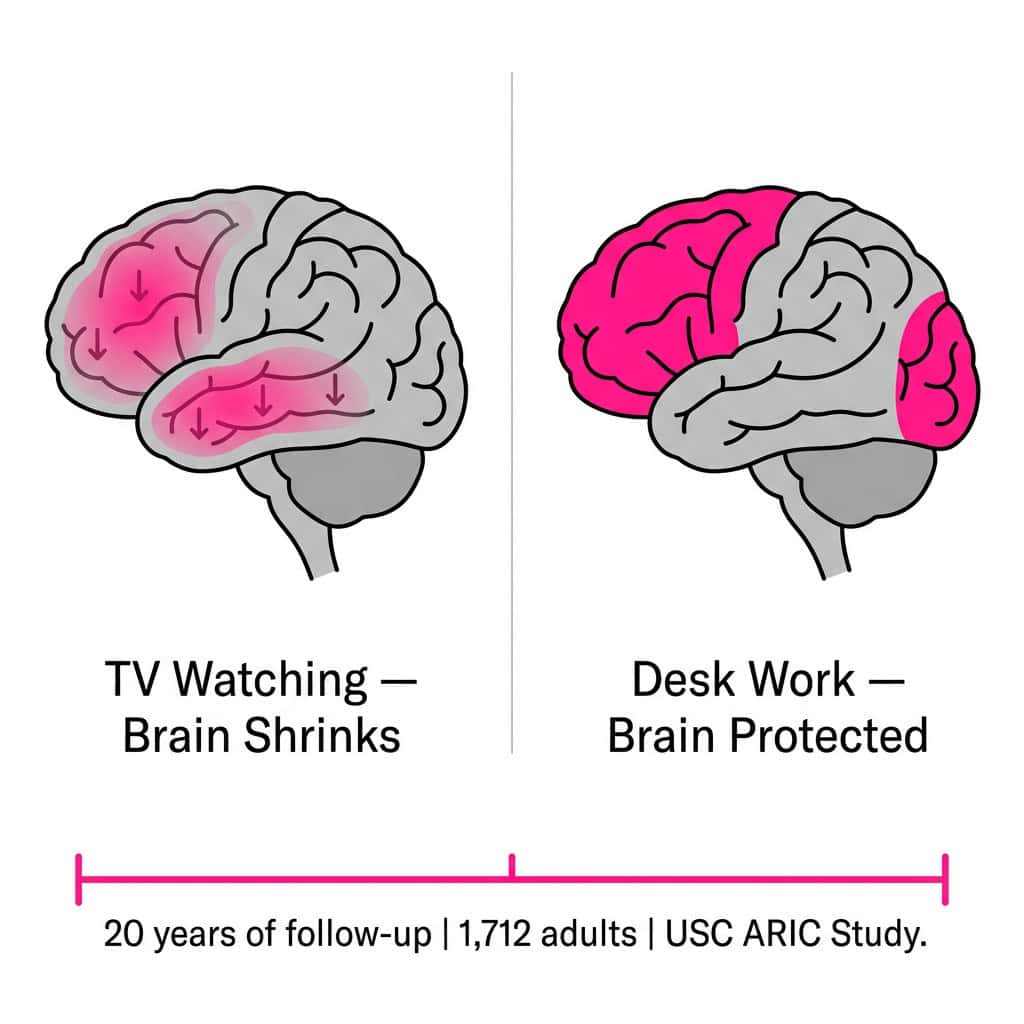
The relationship between sedentary lifestyle and brain health just became dramatically clearer, a University of Southern California study tracking 1,712 adults for more than 20 years, published July 21, 2026 in Alzheimer’s & Dementia: Journal of the Alzheimer’s Association, found that heavy TV watching in midlife caused measurable shrinkage of brain regions governing memory, decision-making, and visual processing, while people who sat for equally long hours doing mentally engaging work actually showed healthier, larger brain structures. “Turn off that TV, it’ll rot your brain!” has been repeated in households for generations, and for the first time, a 20-year MRI study has given that warning its most rigorous scientific validation yet.
The 2026 USC Study: What Sedentary Lifestyle and Brain Health Research Finally Clarifies
This is not a short-term lab study or a food questionnaire. This is one of the longest and most rigorous longitudinal brain health investigations ever conducted, and its findings overturn the simplistic “sitting kills” narrative that has dominated health media for a decade.
The study. Researchers affiliated with the USC Dornsife College of Letters, Arts and Sciences used data from the long-running Atherosclerosis Risk in Communities (ARIC) Study, following 1,712 adults for more than 20 years. Participants had an average age of 53 at enrollment between 1987 and 1989. At enrollment, they self-reported their television watching habits and their occupational sitting time in detail. More than two decades later, these same participants underwent full brain MRI scans — objective, anatomy-level imaging measuring cortical volume, subcortical volume, and white matter hyperintensities. Published as: Natan Feter, Anamika Nanda, Sarah Hourihan et al., Alzheimer’s & Dementia (2026); 22(7), DOI: 10.1002/alz.71582.
The TV watching finding. Compared with those who rarely watched television, people who said they watched TV “very often” in midlife had noticeable differences in brain structure more than 20 years later: smaller brain regions linked to memory formation and early Alzheimer’s, more white matter damage (associated with cognitive decline, vascular dementia, and stroke), and smaller frontal and occipital lobes, the regions governing decision-making, executive function, and visual processing.
The desk work counterintuitive finding, the study’s most important contribution. People who spent a lot of time sitting at work showed healthier brain features than heavy TV watchers: larger frontal and occipital lobes and measurably less white matter damage. Occupational sitting, even long hours of it, appeared protective rather than harmful when it involved mental engagement and problem-solving.
The paradigm-shifting implication. As senior author David Raichlen, professor of biological sciences and anthropology at USC Dornsife, stated: “For years we’ve focused on how much people sit. Our findings suggest we should also pay attention to what they’re doing while they’re sitting.”
That single sentence retires a decade of oversimplified “sitting is the new smoking” messaging. The question was never just how much you sit. It was always what your brain was doing while your body stayed still.
Sedentary Lifestyle and Brain Health: Why TV Is Different From Every Other Type of Sitting
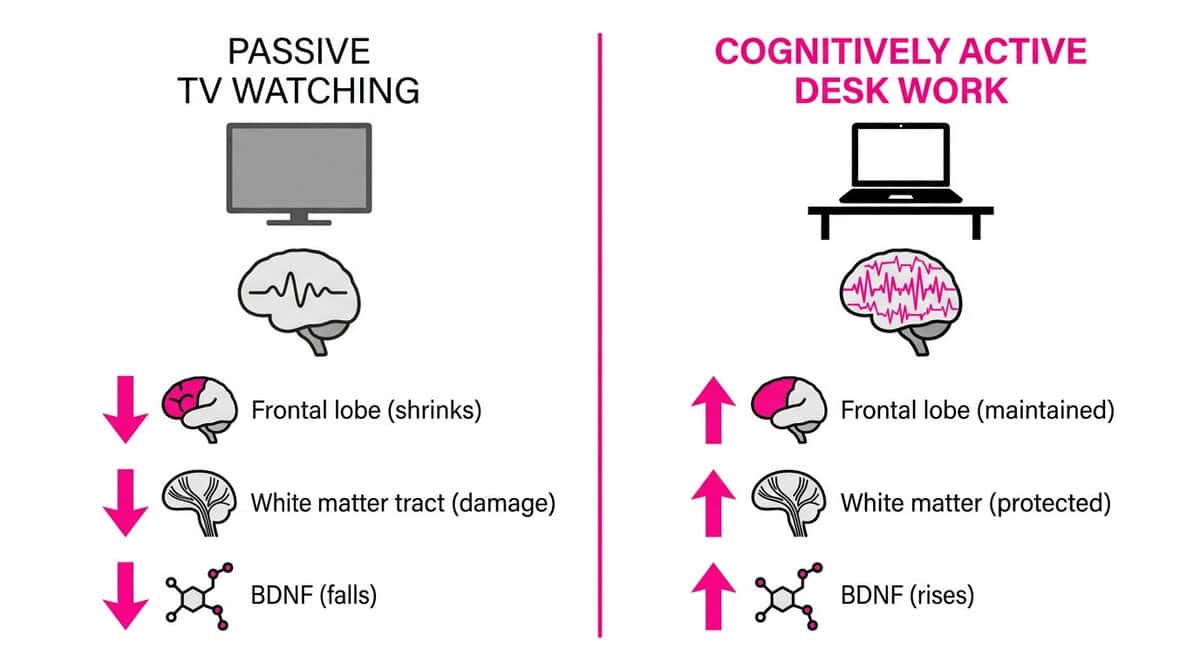
The sedentary lifestyle and brain health connection is more nuanced than the simple “sitting kills” narrative that dominated health headlines for a decade, what the USC ARIC data makes clear is that it is passive, cognitively disengaged sitting that damages the brain, not sitting per se. The biological explanation matters because it changes what to do about it.
The cognitive engagement hypothesis. The fundamental difference between watching TV and doing desk work is the demand placed on the prefrontal cortex, the frontal lobe region most affected in the study. TV watching is passive: the narrative is pre-constructed, the dramatic decisions are made by characters on screen, and the visual cortex processes moving images without demanding the effortful pattern recognition, prediction, and active comprehension that drives neuroplasticity. The brain receives stimulation, but not the kind that requires it to generate new synaptic connections or maintain neural networks through active use.
What desk work does to the brain that TV cannot. Even sedentary office work, sitting at a screen, typing, analyzing, problem-solving, writing, demands sustained attention, working memory, language production, executive planning, and task-switching. These demands trigger BDNF (brain-derived neurotrophic factor) release, stimulate synaptogenesis (new synapse formation), and maintain the neural networks in the frontal lobe and white matter communication pathways that TV watching leaves dormant. The difference is not about physical movement, it is about the brain’s need for genuine cognitive challenge to maintain its structural integrity.
The white matter hyperintensity mechanism. White matter hyperintensities, bright spots visible on brain MRI, represent areas of tissue damage in the brain’s deep communication pathways. They accumulate with cerebrovascular insufficiency: reduced blood flow to deep brain structures. Passive sedentary behavior reduces cerebrovascular circulation over time; mentally demanding tasks require increased cerebral blood flow to sustain neural activity, actively protecting white matter integrity. This is why cognitively engaging desk work appears protective for white matter while passive TV watching is associated with greater white matter damage.
The displacement effect — TV’s hidden additional cost. Hours spent watching television are hours not spent exercising, socializing, reading, learning, or engaging in any of the cognitively protective activities that build the cognitive reserve that delays dementia expression. The brain damage from heavy TV watching may therefore be both direct (passive disengagement) and indirect (displacement of activities that would have been neuroprotective). This cumulative displacement effect over decades is why the 20-year follow-up data showed such pronounced structural differences.
The default mode network. When the brain is not actively engaged in a task, it naturally activates the default mode network (DMN), the self-referential processing system involved in autobiographical memory, social cognition, and future planning. Evidence suggests TV watching may suppress even this passive self-reflective activity, replacing it with externally directed but cognitively passive content consumption. The DMN is one of the first networks disrupted in Alzheimer’s disease, making its chronic suppression through passive TV watching a plausible additional concern.
What Brain Regions Are Affected and Why Each Matters
Frontal Lobe (Most Affected and Most Consequential)
The frontal lobe is the seat of everything that makes humans cognitively distinctive: executive function, planning, decision-making, impulse control, working memory, and personality expression. It is the most evolutionarily recent and metabolically demanding brain region, requiring consistent cognitive challenge to maintain its structure and function.
Heavy TV watchers in the ARIC study showed smaller frontal lobe volumes, smaller brain areas linked to thinking, decision-making, and executive function. This finding connects directly to biological aging research through the same mechanism: cognitive disengagement accelerates epigenetic aging in neural tissue by reducing the BDNF signaling that maintains synaptic density.
Frontal lobe atrophy is a hallmark of both Alzheimer’s disease and frontotemporal dementia, two of the three most common dementia syndromes. Building and preserving frontal lobe volume through cognitively demanding activity is one of the most direct available strategies for dementia prevention.
Occipital Lobe (The Counterintuitive Finding)
The occipital lobe is the brain’s primary visual processing center, and it might seem paradoxical that TV watching (a visual medium) would reduce occipital lobe volume. The explanation lies in the type of visual processing involved. Active visual tasks, reading, spatial navigation, face recognition in social settings, drawing, chess, require the brain to generate predictions, fill in missing information, and actively construct meaning from partial visual data. Passive TV reception delivers pre-rendered images that require no active construction. The occipital cortex processes them, but without the predictive, generative effort that maintains cortical volume through activity-driven neuroplasticity.
Memory-Related Brain Regions
Adults who frequently watched television in midlife later showed smaller volumes in the brain regions responsible for memory, specifically, the structures adjacent to the hippocampus responsible for encoding new memories and the medial temporal lobe network that consolidates them. These are the exact brain regions damaged earliest in Alzheimer’s disease progression.
The connection to existing BillboardHealth research is direct and important: vitamin C supplementation protects gray matter volume in these same regions; vitamin B12 deficiency causes white matter damage in overlapping areas; and deep sleep activates the glymphatic clearance that removes the amyloid and tau accumulation that progressively damages these memory structures. Heavy TV watching simultaneously counteracts all three of these protective mechanisms, through passive cognitive disengagement, sleep disruption from evening viewing, and displacement of physical exercise.
White Matter Hyperintensities: The Brain’s Damage Report
White matter hyperintensities (WMHs) are visible on MRI as bright regions within the brain’s white matter, areas where the deep communication pathways between brain regions have been damaged by reduced blood flow, inflammation, or vascular injury. Heavy TV watchers had significantly more white matter damage than either rare TV watchers or active desk workers.
WMHs are independently associated with: vascular dementia, Alzheimer’s disease risk amplification, stroke incidence, executive function decline, processing speed reduction, and gait abnormalities in older adults. They are not repairable in the way that cortical volume can potentially be rebuilt through activity, they represent permanent structural damage. This makes prevention through maintained cerebrovascular health (physical exercise, cognitively active lifestyle, blood pressure management) critically important.
How Much TV Is Too Much? What the ARIC Data Actually Shows
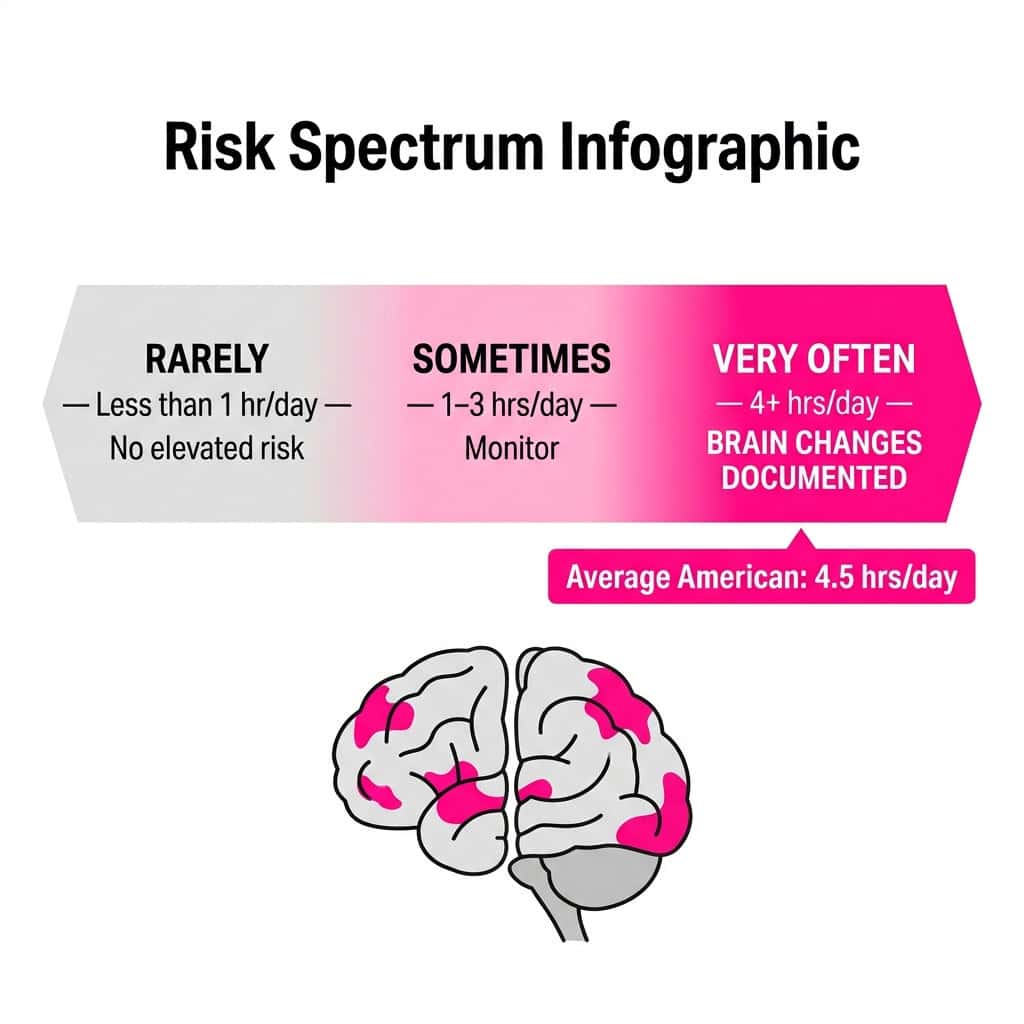
The ARIC study measured TV watching through self-report categories rather than precise hour counts. Based on the study categories and related health behavior research context, here is the practical translation:
| TV Watching Pattern | Approximate Daily Hours | Brain Health Implication |
| “Rarely” | Less than 1 hour/day average | Reference (no elevated brain change risk) |
| “Sometimes” | 1–3 hours/day average | Intermediate; monitor trends |
| “Very often” | 4+ hours/day average | Associated with frontal lobe, occipital, memory shrinkage and white matter damage |
The average American context. According to Nielsen 2026 data, the average American adult watches approximately 4 hours and 30 minutes of television daily, meaning the majority of American adults are in the “very often” category associated with brain structure changes in this study.
The midlife timing matters most. The ARIC participants were approximately 53 years old when TV habits were recorded. This midlife period appears to be a particularly sensitive window for these effects, because it is when neuroplasticity begins to decline while cognitive reserve is still actively building. The brain volume differences were still clearly visible more than 20 years later, meaning midlife habits set the trajectory for late-life cognitive health in a way that is difficult to reverse.
The modifiability opportunity. Unlike genetic risk factors for Alzheimer’s disease, TV watching habits are entirely modifiable. The frontal lobe retains neuroplasticity throughout adulthood, and evidence from exercise research, including the Harvard strength training longevity study documenting 27% lower neurological disease death, confirms that deliberate lifestyle changes can measurably alter brain structure outcomes at any age.
Practical target from the evidence base: limit passive TV to under 2 hours daily; break viewing into 30-minute chunks separated by physically or mentally active intervals; never allow TV to serve as the default evening activity when cognitively engaging alternatives are available.
The Screen Time Paradox: Not All Screens Are Equal
One of the most common questions this study will generate is “what about my phone, computer, and other screens?” The USC finding is specific to passive television consumption, and the science on other screen types is meaningfully different.
Television (passive broadcast) — Harmful per this study. Pre-constructed narrative requires no active decision-making. No interactivity; cognitively disengaged watching is the norm. Typically accompanied by physical immobility, reduced light, and displacement of social and physical activity. The ARIC study directly associates this with frontal lobe atrophy and white matter damage.
Computer/work screen (active engagement), Protective per this study. Requires active problem-solving, writing, reading, analysis, and communication. Demands executive function, working memory, and language processing. Associated with larger frontal and occipital lobes and less white matter damage in the ARIC study. This is cognitively engaged sitting.
Social media — Mixed evidence. Passive scrolling is cognitively closer to TV than to desk work, it demands minimal decision-making and delivers pre-curated content without requiring the user to generate anything. Active engagement (writing thoughtful posts, engaging in substantive discussions) is cognitively closer to desk work. The social connection component of social media has independent value, but passive scrolling for hours daily likely carries similar cognitive risks to TV watching, particularly when it displaces physical activity and social interaction.
Video games — Generally more protective than TV. Action video games improve attention, spatial reasoning, and reaction time in multiple peer-reviewed studies. Puzzle and strategy games maintain executive function in aging adults. The critical variable is active engagement, games that require genuine decision-making, planning, and skill development are cognitively demanding in the same way desk work is. Passive “watch gaming” (watching gaming streams without playing) is cognitively closer to TV.
Reading, Strongly protective. Active reading simultaneously demands visual cortex engagement (active rather than passive), language comprehension, attention sustaining, and imagination, the brain actively constructs the described scenes rather than receiving pre-rendered images. Reading in the evening specifically is an ideal TV replacement: cognitively demanding, low in blue-light emission (physical book), and compatible with the cognitive wind-down profile that supports quality sleep.
7 Evidence-Based Replacements for Passive TV Time
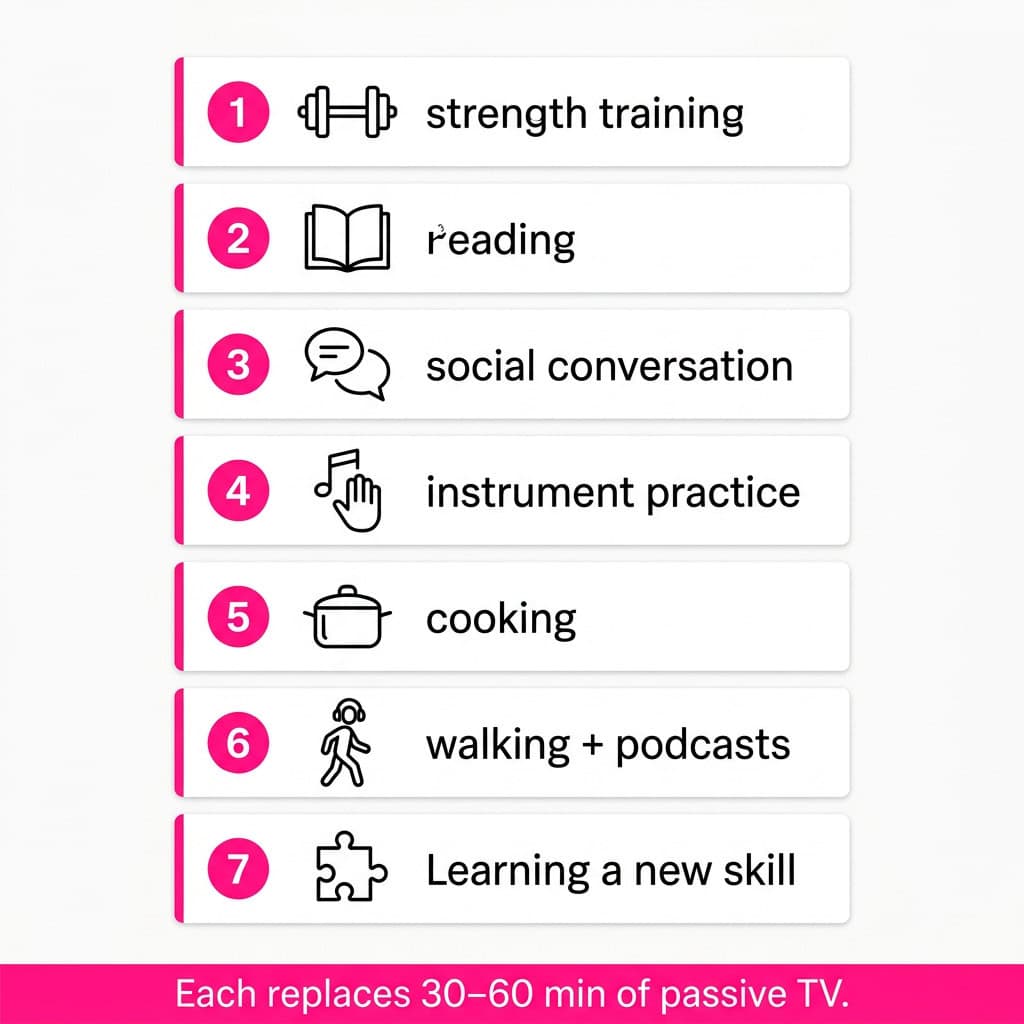
The USC finding identifies the problem specifically: passive cognitive disengagement during sedentary time. The solution is equally specific: replace passive sitting with cognitively engaged activity. Here are the seven highest-value replacements, ranked by the strength and breadth of their brain health evidence.
Replacement #1 — Strength Training (30 Minutes, 2–3× Weekly)
The Harvard 30-year study of 147,000 people found that 90–120 minutes of weekly resistance training reduced neurological disease death by 27%. Exercise directly counters TV’s primary harm through BDNF release, physical exercise is the most potent known stimulus for BDNF production, which drives synaptogenesis and maintains cortical volume in exactly the frontal lobe and hippocampal regions the USC study found most vulnerable. A 30-minute home workout three times per week replaces 90 minutes of passive TV with direct neurological protection.
Replacement #2 — Reading Physical Books (Especially Before Bed)
Active reading is the single activity most directly analogous to cognitively engaged desk work in the leisure context, it demands sustained frontal lobe engagement, language processing, active memory retrieval, and imaginative construction. Reading before bed specifically replaces television’s blue-light sleep suppression with cognitively protective activity that transitions naturally into sleep. Physical books are superior to e-readers for this purpose: lower blue-light emission and no notifications.
Replacement #3 — Social Engagement: Real-Time Conversation
Real-time conversation demands language production, emotional intelligence, memory retrieval, social prediction, and executive function, the full frontal lobe engagement that passive TV consumption bypasses. Consistent social engagement is one of the strongest independent predictors of dementia protection in longitudinal research. Replacing one hour of TV per week with a phone call, dinner, or in-person visit provides cognitive benefits that no solo screen activity can replicate.
Replacement #4 — Musical Instrument Practice
Playing music is among the most cognitively demanding leisure activities available, it simultaneously engages motor cortex (physical technique), auditory cortex (listening and pitch), visual cortex (reading music or watching hands), and frontal executive function (planning, error-correction, coordination). Even beginner practice on guitar or piano for 20–30 minutes daily provides cognitive engagement that far exceeds passive TV consumption at an equivalent time cost.
Replacement #5 — Cooking From Scratch
Active cooking demands reading comprehension, spatial reasoning, sequential time management, sensory integration, and adaptive problem-solving, all frontal lobe activities. Replacing a TV-watching hour with scratch cooking simultaneously improves cognitive engagement AND dietary quality, producing a compound brain health benefit. The Mediterranean dietary pattern that cooking these foods naturally represents is itself associated with slower biological aging and reduced dementia risk.
Replacement #6 — Walking While Listening to Podcasts or Audiobooks
This combination uniquely stacks two independent brain health mechanisms: physical exercise (direct BDNF release, cerebrovascular protection) plus cognitive engagement (narrative comprehension, language processing, sustained attention). A 45-minute evening walk with an intellectually engaging podcast replaces passive TV time with both neuroplasticity stimulus and cardiovascular protection, and eliminates the evening blue-light exposure that suppresses melatonin.
Replacement #7 — Learning a New Skill
Any skill that requires sustained effortful practice, language learning, drawing, chess, coding, pottery, gardening, is neuroprotective precisely because it is genuinely difficult. The frustration of challenge is the brain’s neuroplasticity signal: the formation of new neural pathways requires resistance that passive activities cannot provide. Learning a new language, for example, consistently reduces dementia risk in longitudinal studies and enlarges hippocampal volume in imaging studies.
The 5 science-backed health habits framework provides a practical structure for incorporating these alternatives into daily routines without requiring complete lifestyle overhaul.
The Midlife Brain Window: Why Your 40s and 50s Are the Critical Intervention Period
The ARIC study enrolled participants at an average age of 53, and this timing is not coincidental. Midlife appears to be the critical sensitive window for the TV-brain relationship.
Why midlife matters. Midlife is when neuroplasticity begins its progressive decline, but the brain remains highly responsive to lifestyle intervention. The brain volume changes measured in midlife TV watchers were visible more than 20 years later, meaning the habits formed in your 40s and 50s directly shape your 70s and 80s brain structure. But this cuts both ways: changing habits in your 40s or 50s gives the neuroplastic brain two or more decades to benefit from the intervention.
Cognitive reserve, the protection you build before you need it. Cognitive reserve is the brain’s capacity to function adequately despite accumulating pathology, it is built through years of cognitively demanding experience and eroded through passive, disengaged activity. People with high cognitive reserve can tolerate significantly more amyloid plaque accumulation and white matter damage before showing clinical symptoms of cognitive decline. Midlife TV watching erodes cognitive reserve at exactly the developmental window when it should be accumulating most rapidly.
The spermidine and autophagy research published the same week reinforces this midlife urgency. Autophagy declines throughout middle age, and passive sedentary behavior accelerates this decline by reducing the metabolic demand signals that maintain cellular cleanup machinery. The combination of reduced autophagy, elevated inflammation from passive inactivity, and direct cognitive disengagement from TV watching creates a compounding midlife brain health threat.
Strength training in midlife. The Harvard data found that the mortality benefits of strength training were strongest in the 54-year-old demographic most represented in the study, the same age range as the ARIC midlife enrollment. The intersection of strength training’s neurological protection and the TV-watching risk makes midlife the highest-leverage period for both behaviors simultaneously.
The Double Brain Threat: TV Watching and Sleep
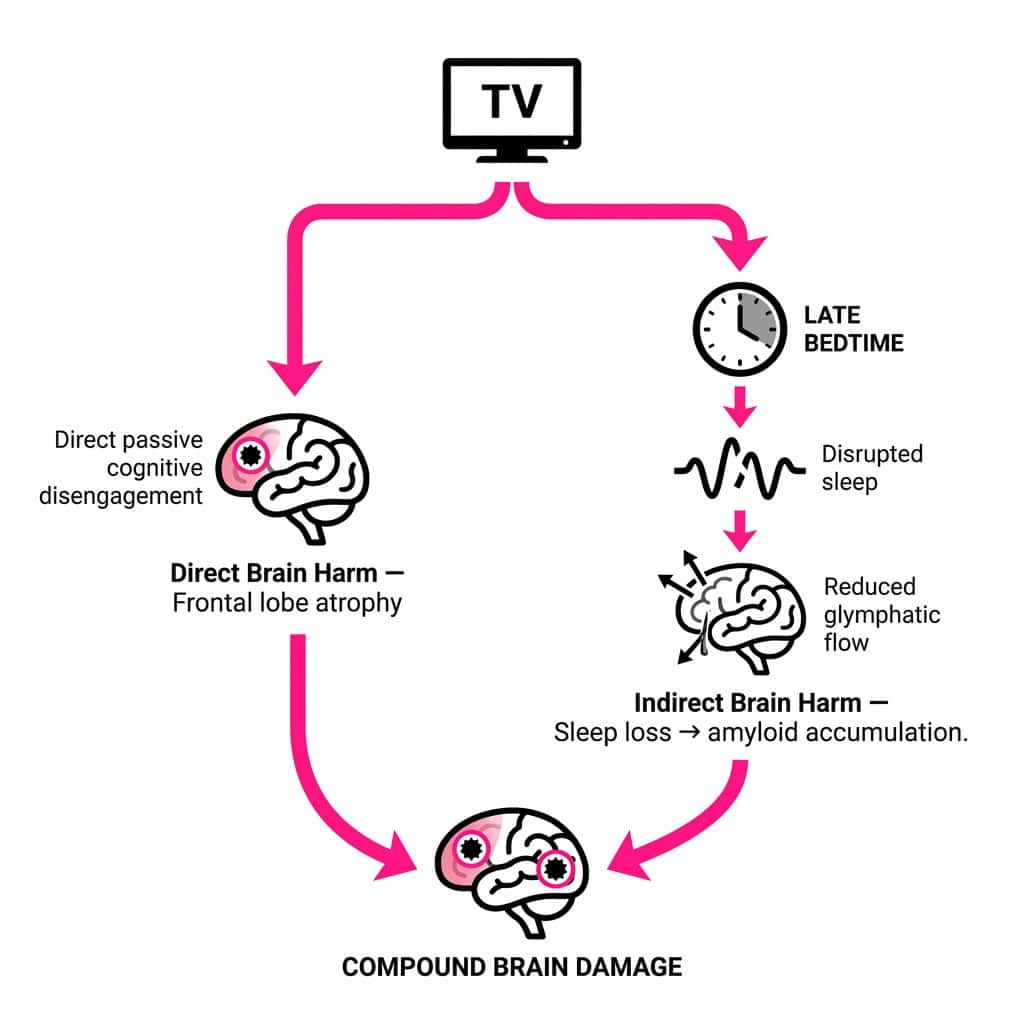
The USC ARIC finding would be alarming enough in isolation. Combined with the sleep science covered in BillboardHealth’s recent series, it becomes urgently compelling, because evening TV watching damages the brain through two fully independent mechanisms operating simultaneously.
Direct mechanism: Passive cognitive disengagement. As documented in the ARIC study, frontal lobe atrophy, occipital lobe shrinkage, memory region volume loss, and white matter hyperintensity accumulation from chronic passive TV watching over decades.
Indirect mechanism: Sleep disruption and eliminated glymphatic clearance. Late-night TV watching is the primary behavioral cause of the 80-minute sleep deficit documented in the Columbia University sleep and weight gain study. The sequence is mechanistically clear: television delays bedtime → the blue-light emission from TV screens suppresses melatonin production by 45–90 minutes → sleep onset is delayed → total sleep is reduced → deep slow-wave sleep is specifically eliminated in the final sleep hours (which are dominated by slow-wave cycles) → the glymphatic system’s amyloid-beta and tau clearance that occurs during deep sleep is severely impaired → these toxic proteins accumulate in exactly the memory-related brain regions the USC study found most damaged in heavy TV watchers.
The practical implication of this double mechanism is that the damage from evening TV watching is significantly greater than the ARIC study alone suggests. The direct passive cognitive disengagement harm adds to the indirect sleep-deprivation-driven glymphatic failure harm, and both target the same anatomical regions.
The solution eliminates both threats simultaneously. Stopping TV 90 minutes before target bedtime and replacing it with reading, conversation, or gentle movement removes the blue-light sleep suppression while substituting cognitively engaged activity for passive viewing. One habit change counteracts both mechanisms at once.
For anyone concerned about both brain health and sleep quality, magnesium glycinate in the evening, which supports GABA-mediated slow-wave sleep onset, further strengthens the sleep quality component of this strategy, giving the glymphatic system its optimal operating window.
When to Be Concerned and When to See a Doctor
The ARIC study data is observational and population-level, occasional TV watching is not dangerous, and a heavy-viewing past is not a guaranteed path to dementia. But there are signs that a physician evaluation for cognitive health may be warranted, independent of TV habits:
Seek medical evaluation if you experience:
- Frequently forgetting recent conversations, appointments, or familiar words
- Getting lost in places you know well
- Difficulty following multi-step tasks you previously managed easily
- Noticeable personality or mood changes noted by family members
- Consistently relying on memory aids for tasks that previously required none
- Inability to recall recent events while older memories remain intact
These signs warrant formal cognitive evaluation, which may include a neuropsychological assessment and brain MRI, regardless of screen time history. Many of these overlap with correctable conditions including vitamin B12 deficiency, thyroid disorders, depression, and sleep apnea, making professional assessment essential before any cognitive decline conclusions are drawn.
This article is for informational purposes and does not replace medical advice. If you are experiencing cognitive changes, speak with your healthcare provider.
FAQs About Sedentary Lifestyle and Brain Health
How does a sedentary lifestyle and brain health interact, is all sitting equally harmful? No, the USC ARIC study clarifies that cognitively passive sitting (TV watching) damages the brain while cognitively active sitting (desk work) is actually protective. The key variable is what the brain is doing during sedentary time, not the sedentary behavior itself.
Does watching TV cause Alzheimer’s disease? The ARIC study found strong associations between heavy midlife TV watching and the specific brain structural changes most linked to Alzheimer’s, frontal lobe shrinkage, memory region atrophy, and white matter hyperintensities. But this is observational evidence, not proven causation. The association is strong enough to take seriously as a modifiable risk factor.
How many hours of TV per day is too much for brain health? “Very often” in the ARIC study context corresponds to approximately 4+ hours daily. The average American adult watches 4.5 hours daily, above the at-risk threshold. Brain health guidelines suggest limiting passive TV to under 2 hours daily.
Why is TV worse for the brain than working at a desk? Cognitive engagement. Desk work requires active problem-solving, language, working memory, and executive planning, stimulating BDNF release and synaptogenesis. TV delivers pre-constructed content requiring minimal active brain engagement. The USC senior author David Raichlen summarized: we should focus on what people are doing while sitting, not just how long they sit.
What brain regions does TV watching affect? Frontal lobe (executive function, decision-making), occipital lobe (visual processing), memory-related regions adjacent to the hippocampus, and white matter communication pathways (white matter hyperintensities).
Can you reverse the brain damage from years of heavy TV watching? The frontal lobe retains neuroplasticity. Strength training, cognitive engagement, and reduced passive viewing can rebuild some of the neural networks that passive TV watching leaves dormant. White matter hyperintensities are less reversible, making prevention more important than recovery.
Is watching TV at night especially bad for your brain? Yes, through two compounding mechanisms: direct cognitive disengagement (USC study finding) AND blue-light suppression of melatonin → delayed sleep → eliminated deep slow-wave sleep → impaired glymphatic amyloid clearance. Evening TV watching is doubly harmful compared to daytime viewing.
Do video games have the same brain effects as TV? No. Active video games (action, strategy, puzzle) demand decision-making, spatial reasoning, and skill development, cognitively closer to desk work than TV. Passive gaming (watching streams without playing) is more similar to TV in cognitive profile.
At what age does TV watching start affecting the brain? The ARIC study identified midlife (around 53) as the critical exposure window, with effects visible 20+ years later. Midlife is when cognitive reserve is most actively building, or most easily eroded.
What is the healthiest evening alternative to TV watching? Reading physical books provides maximum cognitive engagement with minimal blue-light disruption, the ideal TV replacement for both brain health and sleep quality. Musical instrument practice, social conversation, and skill learning all rank highly for cognitive demand.
Consult your healthcare provider if you are experiencing cognitive changes, regardless of your screen time history.